
Introduction
Most births occur during daylight hours and reputedly between 0800 and 1400 hours.
Physical signs of approaching parturition are often imperceptible but changes in general behaviour are usually the most obvious outward sign that birth is imminent. Physical signs may include relaxation of the vulva, loss of the cervical mucus plug, slight increase in the size of the mammary gland and waxing of the tips of the teats (only if previously given birth). Behavioural changes may include some, all or indeed none (!) of the following: signs of obvious discomfort (including rolling and frequently lying down and getting up), frequently looking at their tail, they may place themselves in isolation to the rest of the herd and frequent visits to the dung pile with little or no defecation. Other body language includes sitting on one hip, ears laid back, and back arched.
Labour
Normal labour is a continuous process initiated by hormonal changes but it can be broadly divided into three stages.
Stage 1
The cervix relaxes and uterine contractions commence to propel the foetus into the birth canal. This stage may last 2-6 hours (or longer in first pregnancies). Signs include restlessness, discomfort, increased humming, increased defecation and urination, segregation from the herd and decreased appetite. Many alpacas show no obvious signs of being in first stage labour.
Stage 2
Uterine contractions increase in frequency to aid expulsion of the foetus. The female may lie down and rise up several times; there is abdominal straining; the amniotic sac (or water bag) may appear at the vulva and rupture. (Note: much less fluid is released than in other species). Both forelimbs appear together at the vulva and the head emerges either above or below the legs. Once the head appears, delivery is usually completed quickly but the female may rest before pushing out the shoulders. Most females deliver in the standing position. Stage 2 is usually completed in 30-45 minutes.
Stage 3
The placenta or afterbirth is usually expelled within 2 hours of birth. Alpacas do not eat the afterbirth nor lick their offspring.
Veterinary attention is required if –
- Stage 1 exceeds 5 hours without signs of abdominal contractions.
- Stage 2 extends beyond 30 minutes without any signs of progression.
- Stage 3, if the afterbirth has not been expelled within 6-8 hours (or by the next morning for late in the day deliveries.)
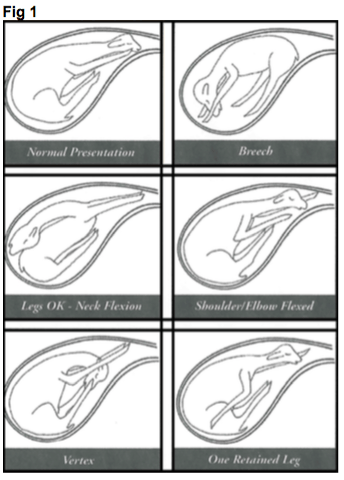
Dystocias (Difficult births) – See fig 1
In alpacas the dystocia rate is low (2%-5%) but in such cases immediate assistance is generally required.
Most dystocias are due to abnormal presentation or position of the foetus in the uterus.
Dystocia may also be caused by maternal reproductive problems such as infection, poor nutrition or obesity where excess fat in the birth canal reduces the area for the foetus to pass through. The dam (or mother) may become exhausted after prolonged unsuccessful efforts to deliver the foetus.
Shoulder/elbow flexion is the most common dystocia. Deviations of the head and neck are difficult to correct due to the long neck of the foetus. Backwards (hind legs presented first) or Breech presentations (buttocks and backbone jammed against the birth canal) are serious dystocias and require veterinary assistance.
Cria Care
The newborn cria is often covered by a very thin membrane which dries and rubs off easily. This may need to be gently removed if it is around the nose and mouth.
After a successful birth cria and dam should be left alone to bond. Observations should be made from a distance.
The cria should:
- be active almost immediately
- have easy respiration
- sit up in the ‘cush’ position within 5-10 minutes
- be attempting to stand within 30 minutes and standing within 2-3 hours
- be attempting to suckle within 60 minutes and suckling within 4 hours
- have a birth weight of between 6.5 kg – 8 kg
- have a normal temperature of between 36.8 oC & 39.2 oC (local weather conditions should be taken into account i.e. contingencies should be considered if there is a low cria temperature in wet and windy weather)
If any problems are evident then immediately consult a veterinarian.
Post-partum Problems
Problems after parturition (i.e. Post-partum) are uncommon, but may include prolapse of the uterus (Vaginal prolapse is very rare after parturition. It normally occurs before parturition), hemorrhage, uterine tears and uterine infections. Good hygiene is important when dealing with a dystocia to reduce the risk of introducing infection into the uterus.
Post-partum Breeding: When to rebreed?
Involution (i.e. return to normal size) of the uterus progresses rapidly in alpacas and is complete by three weeks after parturition. A small amount of discharge, often blood tinged, is sometimes seen during the first 5-7 days post-partum.
In general, rebreeding should be delayed until 15- 20 days post-partum, and occasionally a female may not be receptive for up to 40 days post- partum.
Infertility
Compared with many other livestock, infertility in alpacas is relatively uncommon and most problems can be resolved using different management strategies. Fertility problems should always be discussed with your veterinarian, who will be able to carry out the necessary reproductive examination and fertility assessment. Alpaca owners should keep good breeding records, as an accurate history is a vital part of any fertility assessment.
Information sheet reproduced from the British Alpaca Society.