
Alpacas have soft padded feet with two toenails on each foot and a soft leathery pad. Most alpacas kept in the UK are grazed on ground which can differ significantly from that of their natural habitat. Depending on the environment the toenails require regular attention at least three to four times a year and at shearing. However, nails will grow at different rates on different animals and in particular the toenails of lighter coloured animals seem to grow at a faster rate and are often thicker than the darker coloured animals. Nails left unattended can twist and deform the foot causing lameness, restriction of mobility and ability to move to graze, and ultimately weight loss.
Trimming technique
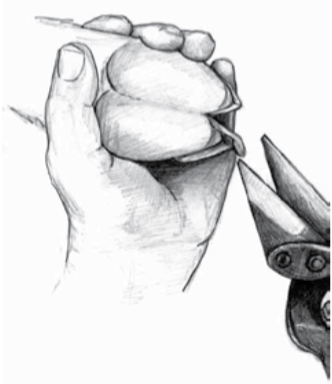
Animals accustomed to being handled and having their toes trimmed are relatively easy to manage. Firm but gentle restraint is far more effective than force and mechanical restraint (e.g. a crush) and is less stressful for the animal. One person gently restrains the animal with the second person carefully trimming the nails. Using a pair of straight-edged cutters (footrot shears, hoof snips or straight edge secateurs) the second person lifts the foot and trims the nails level with the soft pad. Care must be exercised to prevent cutting too deeply and causing bleeding. If this occurs, spraying with an antiseptic solution will minimize the risk of infection.
Disclaimer: The management practices detailed in this overview do not constitute veterinary advice. Any alpaca appearing to have an adverse condition should be assessed by a veterinarian.
Taken from The British Alpaca Society Fact Sheet.
Information sheet reproduced from the British Alpaca Society.