Natural Grazing Conditions
The alpaca belongs to a group of animals known as the South American camelids (SAC). The SAC are separated from true ruminants such as sheep and cattle partly because they differ in the structure of their stomachs.
In South America, alpacas are found at an elevation of 4400-4800 m where they are strict grazers, preferring the bottomland vegetation of meadows and marshes. The largest populations of alpacas live in the Bolivian and Peruvian Altiplano of the Andes Mountains at over 3800m above sea level. The region has a short growing season between December and March with 75% of the rainfall, and a long dry season from May to October when there is almost no rainfall.
Peruvian studies have shown that alpacas consume tall grasses in the wet season and short grasses in the dry season. Alpacas are highly adaptable grazers that will eat grass when it is available but they will adapt to sedges during dry periods of low grass availability.
The sedge family (Cyperaceae) comprises annual and perennial grass-like or rush-like plants which usually show a preference for marshy or wet places but a few also occur on dry sandy soils with unimproved pasture. On improved pasture, sheep will eat at least 2.5 times more legumes such as clovers than alpacas, so alpacas still prefer grasses even in this situation.
Anatomy of the digestive tract
The digestive tract is considered to be from the lips to the anus. The lips of alpacas are unique because the upper lip is split by a labial cleft so that each side of the lip can move independently, allowing alpacas to be very selective about what they choose to eat.
The tongue does not participate in grabbing food (in contrast to cattle) and rarely comes out of the mouth, so alpacas do not readily lick themselves, their young, or most importantly for nutrition, some will not lick mineral blocks/buckets. If you wish to use blocks/licks or buckets please ensure you can confirm their use (or not).
The incisor teeth of alpacas are firmly fixed in the lower front of their jaw, like sheep and goats, and take about 4.5 years for complete replacement and development. The jaw movements allow for efficient cutting and grinding of their food but often chewing is cursory, used mainly for mixing with saliva.
Saliva has three important functions:
- Lubrication of dry feed.
- Adding bicarbonate and phosphate tobuffer against acids during fermentation.
- Recycling nutrients such as urea and phosphorus.
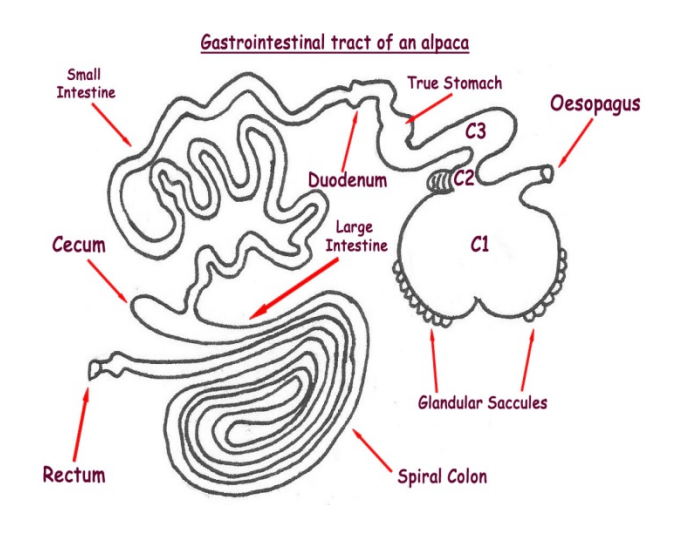
The alpaca stomach has three compartments (C-1, C-2 and C-3) and is not analogous to any of the true ruminant stomachs.
Neonates have a large true stomach but a poorly developed C-1. By 8 weeks of age, the C-1 reaches adult proportions. It takes about 12 weeks to reach full adult activity allowing the breakdown of plant fibre.
C-1 lies on the left hand side of the abdomen and makes up about 80% of forestomach volume.
C-2 makes up 6%. (Together they contain 10-15 litres of digesta.) There are also glandular saccules across the ventral surfaces of C-1 and C-2.
This glandular area has many functions including:
- Absorption of nutrients.
- Addition of mucus secretions, glycoproteins and urea to provide an optimum environment for the microbes.
- Possibly secrete bicarbonate ions (findings not repeated experimentally) to buffer C-1 and C-2 contents.
The opening between C-1 and C-2 is large (mineral pellets do not remain in C-1 for any significant period of time) and the pH ranges from 6-7.
C-3 (11% of forestomach volume) is tubular and runs next to C-1 on the right side of the abdomen. The last one-fifth has true gastric glands and it has a pH of 2-3. Solutes and water are rapidly absorbed.
Motility (spontaneous movements) of the forestomaches is critical for continual fermentation. Alpacas have greater forestomach motility than ruminal contraction of true ruminants. The motility of C-1 and C-2 mixes ingesta so that there is little layering of feed. The motility allows constant exposure of feed to microbial activity and subsequent degradation.
Gas is produced by the microbes in C-1. Eructation (belching) occurs 3-4 times during each motility cycle. Increased stomach motility pattern may explain why alpacas are relatively resistant to foregut gas accumulation and clinical bloat compared with true ruminants. Regurgitation (backward flowing of food) occurs during mixing and stomach contents are sucked into the oesophagus and carried by an antiperistaltic wave to the mouth. Large fibres are regurgitated to allow more chewing to increase surface area for bacterial colonisation and stimulate saliva production.
The small intestine is 8 m long in an adult alpaca and digests and absorbs nutrients. It runs into the caecum and large intestine (6 m long).
The large intestine:
- Absorbs water.
- Absorbs minerals and vitamins.
- Secretes mucus.
- Allows further microbial action on digesta.
Due to the efficiency of digestion of C1 – C3, there is little left for the large intestine to ferment which reduces the risk of starch fermentation and hindgut acidosis.
Alpaca faeces are pelleted and begin to form at the start of the spiral colon. Alpacas usually use a communal dung pile for defecation and urination and generally avoid grazing near these areas.
Digestive Physiology
The first compartment of the stomach (C-1) is a large fermentation vat. As with ruminants, alpacas have a vital symbiotic relationship with the microscopic organisms that live within the gastrointestinal tract. These organisms break down the cellulose in the feed that the alpacas eat. The alpaca provides the feed and stable environment (relatively neutral pH, anaerobic, moist medium) whilst the single celled organisms break down the food that is eaten.
Fungi colonise the plant material and weaken the structure of the plants so that bacteria and protozoa can attach. All these organisms use various breakdown products of the ingested plants to reproduce themselves.
The microbes contain the enzymes to break down cellulose, urea and protein using the carbon and nitrogen for their own growth. By-products from microbial growth and multiplication are then used by the alpaca. These include volatile fatty acids which provide the alpaca with energy and Bcomplex vitamins. The microbes themselves are washed from C-1 down to C-3 and the intestine where they are digested to provide the alpaca with protein and other nutrients.
NOTE: When you feed an alpaca, you are also feeding the microbial population in C-1 and C2. The population dynamics of different species of bacteria in C-1 and C-2 depend on the prevailing source of ingested material. This is why it is very important to introduce any feed changes gradually. It is necessary to give the microbial population a chance to adjust to any change in conditions. Access to good quality hay for two or three weeks during change- over provides a healthy buffer.
Why alpacas perform better than sheep when on poor quality forage:
- Slower particulate passage time (microbes have longer to attack structural carbohydrates in C-1 – 63 hours in alpacas, compared with 41 hours in sheep).
- Faster liquid passage time (constant removal of microbial protein, vitamins and soluble minerals from C-1 and C-2 maintains a rapidly dividing population of microbes which is more efficient. Liquid flow is 10.4% per hour in alpacas, compared with 7.7% per hour in sheep).
- Greater volume of saliva production (in relation to foregut volume).
- Efficient output of energy and protein on limited quality feed.
- Efficient nitrogen balance (by reduction of urea excretion through kidneys, thereby enabling recycling of urea through their saliva and directly through the wall of C-1).
Eating Behaviour of Camelids
The basic requirements for alpacas are water, energy, protein, fibre, vitamins and minerals. It is essential that requirements of the first four essentials (water, energy, protein and fibre) are satisfied before assessing vitamin and mineral status.
- Alpacas in groups are contented, more productive and healthier.
- They tend to be active at dawn and dusk.
- They eat for 5-6 hours per day – hot weather can reduce grazing time.
- They ruminate for 8-9 hours per day – longer on high fibre diets.
- They rest for 7-8 hours per day.
- They urinate / defecate / interact for 3 hours per day.
Avoid competitive feeding situations when supplementing your alpacas by allowing adequate trough space. Dominant alpacas will eat more than the shy feeders if inadequate space is provided.
Paddock Feed
Alpacas are primarily grazers and eat small amounts of a wide variety of plants. They will eat approximately 2% of their body weight in feed per day and prefer shorter pastures. Ideally they should have a diet consisting of 20% fibre.
They are very effective at extracting nutrients (protein and energy) from the available feed. Alpacas are efficient recyclers of urea and protein levels of 10-12% only are required.
Although they can survive harsh conditions they do best on good quality pasture. The growth of a variety of grasses and forbs (non-grass plants e.g. comfrey, small burnet, and chicory) in quality soils will provide your alpacas with good nutrition.
Care should be taken to avoid poisonous plants in your pasture or hanging over fences into alpaca paddocks, such as highly toxic oleander, lantana rhododendron etc.
Supplementary Feeding
In seasons where pasture becomes limited, alpacas may be supplemented with good quality pasture hay and/or various grains according to their physiological state (e.g. pregnancy, lactation, growth, maintenance) and body condition score. Roughage in the form of hay / haylege etc. should be available at all times.
Pregnant and lactating females need a higher daily intake than other alpacas. They may need additional supplement above that given to the rest of the herd in order to maintain or recover condition.
Soils in the UK are often deficient in certain minerals and trace elements. Pastures and soils can be analysed to assess any areas of deficiency and it is important that this be done to avoid using unnecessary additives.
Alpacas can be supplemented using a variety of commercial mixes designed for alpacas, and some non-alpaca specific feeds and supplements can be used, however it is important to understand what the composition of the feeds are that you may be giving in order to ensure the correct balance of minerals and nutrition.
Further Reading
Veterinary Treatment of Llamas and Alpacas
Nutrition of the alpaca.
Proc Int Alpaca Industry Conference, Perth, Western Australia 1998 pp60-70.
Mineral and vitamin needs of alpacas
Proc Aust Camelid Vet Assoc, Perth, Western Australia 2000 pp45-58
Nutrition. In: Camelid Medicine and Surgery, Post Graduate Foundation in Veterinary Science, Proceedings 278, 1996, pp 47-74.
Nutrition and Mating, WA Central Region Conference Notes, June 2007
Managing Alpacas in Australia, Edition 3
Poisonous Plants Leaflet – 2017
Llamas and Alpacas: A Guide to Management
Veterinary Techniques for Llamas and Alpacas
The Complete Alpaca Book 2nd Ed revised
Llama and Alpaca Care : Medicine, Surgery, Reproduction, Nutrition and Herd Health 1st Ed
Disclaimer: The management practices detailed in this overview do not constitute veterinary advice. Any alpaca appearing to have an adverse condition should be assessed by a veterinarian.
Information sheet reproduced from the British Alpaca Society.