Important Note
This information is provided as a guide for the administration of injections but breeders may have similar techniques which are equally effective. As with most livestock alpacas require injections from time to time but there are no medications in the UK which are licensed for use in alpacas.
Please consult your veterinarian.
These procedures must be done correctly to prevent:
- Poor absorption.
- Failure to be effective.
- Risk of infection.
- Accidental human injection.
Preparing for the injection
Preparation for giving injections should be carefully planned to minimise tress to both the animal and the handlers.
First ensure that the drug is the correct one, read the label and follow the instructions which will include:
- Dosage and administration technique.
- Expiry date.
- Warnings and contraindications.
- Handling and storage instructions.
Technique for preparing the injection
- Wash hands before starting and use sterile equipment.
- Make note of the batch number on the bottle used (if multiple bottles – make a note of the specific batch number for each animal) in case of any issues.
- Use a separate needle for each injection wherever possible.
- Select the smallest gauge needle that can still handle the volume and viscosity of the product. Needles are colour coded for gauge. The higher the size number, the finer the bore/gauge of the needle.
- Shake product regularly to ensure proper suspension in the container.
- Do not mix products.
- Only insert sterile needles into the bottle. If multiple injections are required, leave a needle in the bottle and use a separate one for the injections.
- Remove dispensing needle before storage.
- Inject air into the bottle before withdrawing the drug. This equalises the pressure.
- After withdrawing drug, hold the syringe and needle up and tap to move air bubbles up.
- Push plunger carefully to remove any air.
Routes of administration
There are four main routes of administration of drugs by injection in the alpaca. These are:
- Intravenous (IV) Should only be administered by veterinarians. Reasons for IV may include the taking of blood for laboratory examination, administration of anaesthetic agents, and blood or plasma transfusions.
- Intraperitoneal (IP) Should only be administered by veterinarians. This method is sometimes used for the administration of plasma to the newborn cria.
- Intramuscular (IM) A common method used by breeders for the administration of several drugs e.g. antibiotics, vitamins etc.
- Subcutaneous (SC) Probably the most common method used by breeders for the administration of drugs e.g. parasite control etc.
Injection techniques
The method of administering the injection will be stated on the bottle or in the accompanying literature and must be followed. In both cases it is preferable to inject when the animals are dry to reduce the chance of introducing foreign matter/bacteria.
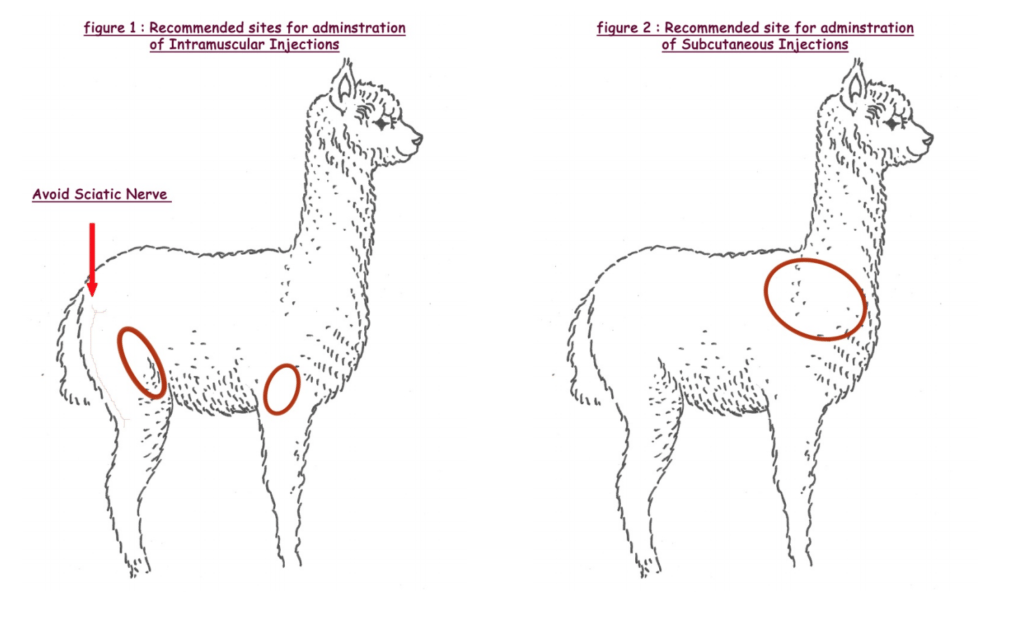
Intramuscular (IM) – See Figure 1 Use a needle long enough to penetrate the skin and fat into the muscle. Make sure needle is perpendicular to the body. Pull back slightly on the plunger before injecting to make sure you are not in a blood vessel. Inject slowly and gently massage the area when the needle is withdrawn.
Subcutaneous (SC) – See Figure 2. Use a narrow gauge needle but appropriate for the agent being administered. Lift the skin and inject into the ‘tent’ at an angle of 30 degrees to the body. (This technique can be difficult if the animal is in full fleece), or hold the syringe at a 40 degree angle to the skin whilst injecting, alternatively some breeders find that cutting the end off the needle guard and allowing the needle to protrude only a few millimetres acts as a depth gauge. NB cut the needle guard only – do not attempt to cut the needle! When injecting SC pull back on the plunger once you have inserted the needle – there should be resistance – if you get no resistance you have probably gone through the ‘tent’ and out the other side, if you get blood in the syringe you are in a blood vessel and you should remove & replace the syringe and try again in a different location at least 1 inch away from the initial injection point (failure to move far enough away can cause leakage of the drug etc. out through the first ‘hole’ in the skin. After administering check fleece is dry – wet fleece may indicate the needle has been pushed through both sides of the ‘tent’ and the agent dispensed into the fleece on the other side. If the animal moves mid injection such that the needle is withdrawn from the skin complete the injection at least 1 inch away from the original site to ensure there is no leakage.
On completion
Following the administration of any drugs:
Maintain permanent records for each animal which should include:
- Date of administration.
- Product name.
- Dosage.
Dispose of needles responsibly eg. in sharps bin. Wash hands and equipment. Monitor animal’s response for any adverse reaction.
Disclaimer: The management practices detailed in this overview do not constitute veterinary advice. Any alpaca appearing to have an adverse condition should be assessed by a veterinarian.
Information sheet reproduced from the British Alpaca Society.